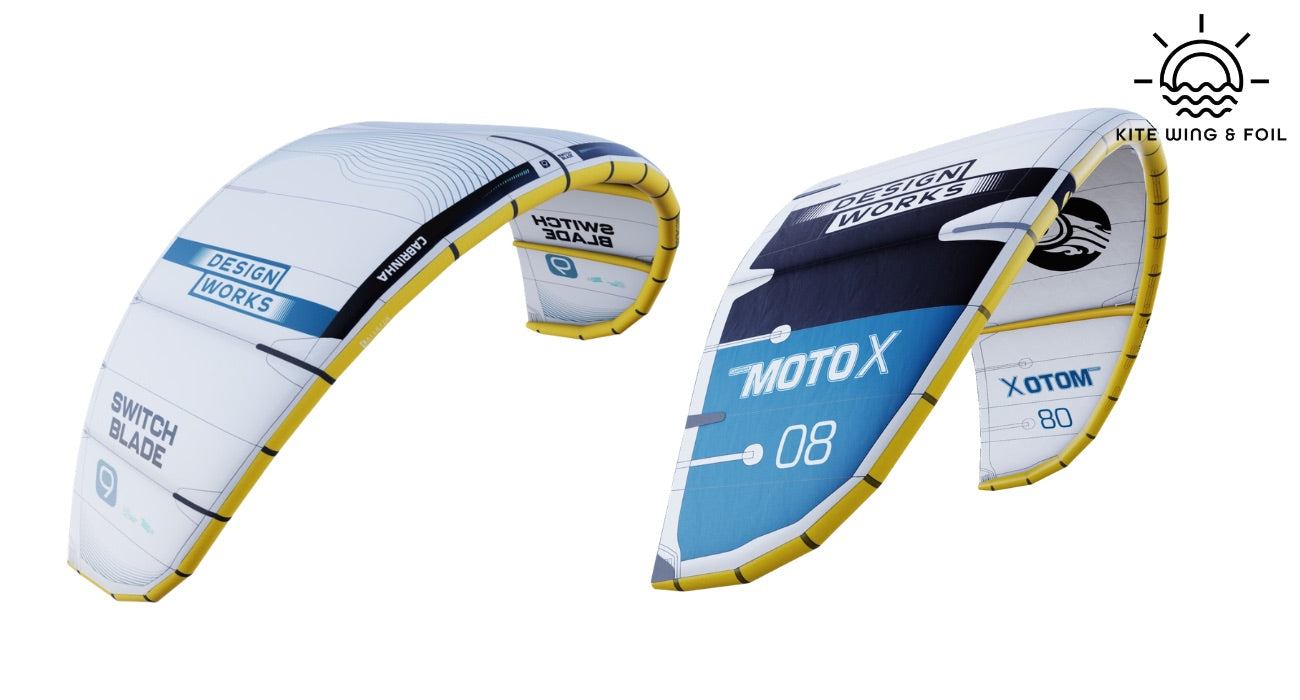
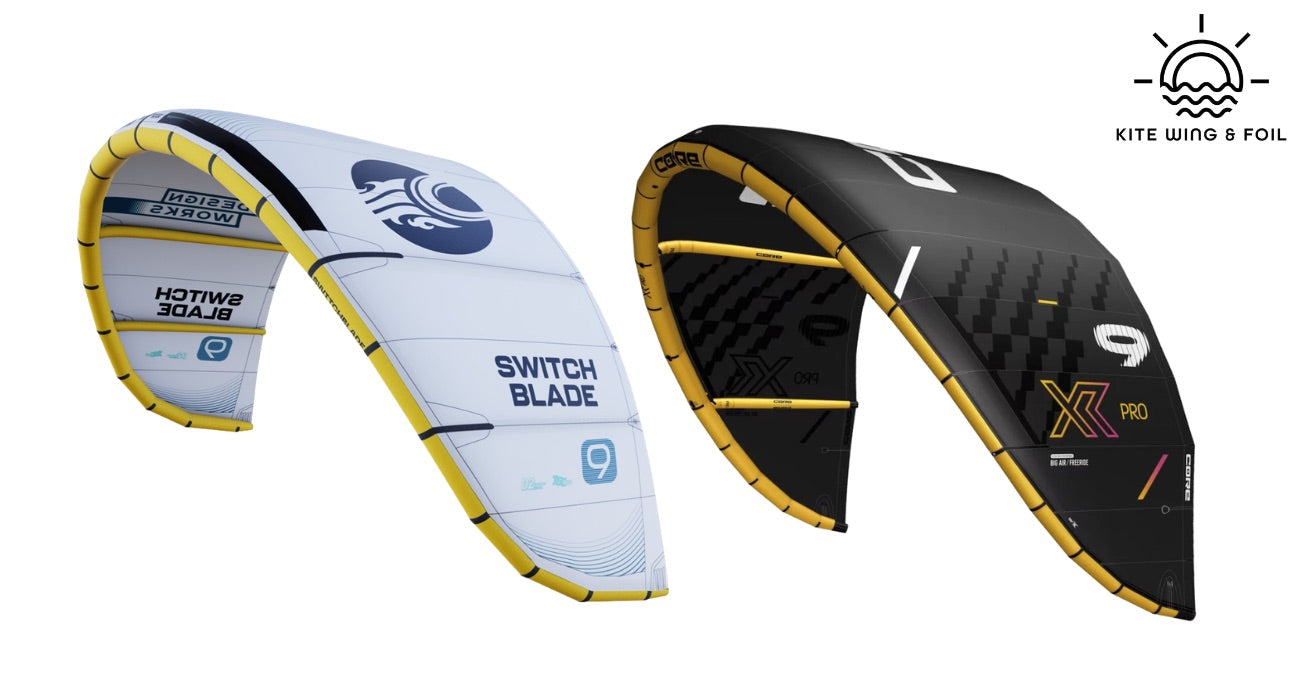
Cabrinha Switchblade Design Works 2026 vs CORE XR Pro 2 – Which Premium Big Air Kite?
Cabrinha Switchblade Design Works 2026 vs CORE XR Pro 2
Two premium five-strut Aluula kites with different priorities. The Cabrinha Switchblade Design Works combines high-performance boosting with predictable freeride control, while the CORE XR Pro 2 is tuned more uncompromisingly around maximum height, hangtime and powered big-air performance.
- Choose the Switchblade Design Works for premium freeride performance, predictable boost timing and a more versatile, confidence-inspiring character.
- Choose the CORE XR Pro 2 if maximum height, extended hangtime and dedicated powered big-air performance are the overriding priorities.
- For controlled big-air progression: Switchblade Design Works.
- For uncompromising height and hangtime: XR Pro 2.
- For freeride versatility: Switchblade Design Works.
Check current sizes, pricing and availability, or contact us for help comparing it with your existing big-air kite.
The main difference
The key difference is how narrowly each kite defines its purpose. Both use premium Aluula airframes and stable five-strut structures, but their design priorities are different.
The Cabrinha Switchblade Design Works 2026 starts with the familiar Switchblade formula: predictable handling, strong upwind drive, controlled power and confidence when riding fully powered. Cabrinha then reduces weight and leading-edge diameter, increases aspect ratio and uses a full Aluula frame to improve efficiency, responsiveness and kite speed.
The CORE XR Pro 2 is positioned more explicitly as an ultra-high-performance big-air kite. Its refined Aluula frame, flatter Delta Bow profile, Intelligent Arc and pulley-supported bridle are designed around powerful lift, extended hangtime and high-end performance.
Switchblade Design Works vs XR Pro 2: quick comparison
| Feature | Switchblade Design Works 2026 | CORE XR Pro 2 |
| Primary category | High-performance freeride | Ultra-high-performance big air / freeride |
| Airframe | Full Aluula frame | Aluula five-strut light frame |
| Canopy | Teijin D2 ripstop | CoreTex 2 triple ripstop |
| Struts | Five | Five |
| Bridle concept | Vert-X bridle with High-Y or Low-V setup | Pulley bridle with Intelligent Arc |
| Bar pairing | Cabrinha Unify High-Y or Low-V configuration | Optimised for CORE Sensor 4 deep-Y setup |
| Boosting character | Powerful, predictable and easy to time | Explosive lift with maximum-height focus |
| Hangtime | Long and controlled | A central design priority |
| Freeride versatility | Excellent | Strong, but more performance focused |
| Sizes | 8m, 9m, 10m, 12m | 5m, 6m, 7m, 8m, 9m, 10m, 12m |
| Best suited to | Premium freeride and controlled big-air progression | Experienced riders chasing height and hangtime |
Aluula construction and frame stiffness
Both kites use Aluula because its high stiffness-to-weight ratio allows the airframe to remain highly supported under load without the weight associated with conventional leading-edge materials.
Cabrinha has not simply transferred the standard Switchblade geometry onto an Aluula frame. The Design Works version uses a slightly higher aspect ratio, a significantly reduced leading-edge diameter and more efficient aerodynamic profiles. These changes are designed to improve flight speed, upwind performance and steering response.
CORE also refines the leading-edge diameter on the XR Pro 2, using a tapered shape to preserve stiffness while improving turning agility. Kevlar reinforcement patches are added at high-load areas, while the five-strut frame is intended to retain its profile when heavily loaded.
Which kite boosts higher?
On manufacturer positioning alone, the CORE XR Pro 2 is the more uncompromising height-focused kite. CORE describes maximum height and hangtime as its central objective, with the Intelligent Arc increasing projected area as the rider sheets in.
Its pulley bridle is retained to help riders locate a consistent take-off point, while the flatter profile and fast forward flight are designed to support explosive lift and high-end efficiency.
The Switchblade Design Works should still offer very strong boosting performance, but its advantage is likely to be how accessible and repeatable that performance feels. The established Switchblade character is built around predictable power and clear timing rather than demanding that every rider operate at competition intensity.
Choose the XR Pro 2 if the primary objective is extracting maximum height and hangtime. Choose the Switchblade Design Works if you want premium boosting performance combined with predictable timing and broader freeride usability.
Hangtime and landing control
The XR family has long been associated with glide and hangtime, and the XR Pro 2 continues that positioning. Its projected-area adjustment and bow-derived geometry aim to produce a powerful lift curve followed by extended airborne support.
The Switchblade Design Works is also designed to provide substantial lift and support, but with a more familiar Switchblade-style emphasis on predictable redirection and confidence through the landing phase. Riders who value consistency from take-off through touchdown may find that character easier to integrate into ordinary freeride sessions.
Kiteloops and turning behaviour
Both manufacturers have worked to increase turning performance without sacrificing the structural support expected from a five-strut big-air kite.
The Switchblade Design Works uses a reduced leading-edge diameter and revised profiles, while its Vert-X bridle allows riders to choose between High-Y and Low-V configurations. Cabrinha states that the High-V option improves steering speed, turning radius and bar feedback, producing a more pivot-driven turn with reduced pull through loops.
CORE has tapered the XR Pro 2 leading edge and introduced Kevlar patches intended to improve agility. Even so, its underlying character remains centred on powerful big-air performance rather than becoming a lightweight three-strut looping kite.
Bridle and control-bar differences
The Switchblade Design Works can be configured around Cabrinha's Unify High-Y or Low-V setup.
- High-Y and Low-V choice
- Allows riders to alter overall handling feel
- Designed around the Cabrinha Unify control system
- Apex low-elongation bridle material
The XR Pro 2 retains a pulley bridle and is optimised around the deeper-Y Sensor 4 bar configuration.
- Pulley-supported bridle
- Projected area changes as the kite is sheeted
- Three tip and bridle trim settings
- Designed to work with the CORE Sensor 4 bar
These kites should be used with the control-system geometry recommended by the respective manufacturer. Do not assume that all four-line bars provide the intended safety operation or flying-line split.
Freeride performance and everyday usability
This is where the Switchblade Design Works should have the clearest advantage for many non-competition riders. Its design begins with a freeride platform known for dependable power delivery, upwind drive and predictable control.
That makes it easier to justify as an everyday premium kite: freeride cruising, powered edging, boosting, long sessions and big-air progression all sit naturally within its intended use.
The XR Pro 2 can certainly be ridden for freeride, and CORE includes freeride within its category. However, its defining characteristics and premium construction are targeted more directly at riders chasing high-performance big air.
CORE XR Pro 2 size and published wind range
| Size | 5m | 6m | 7m | 8m | 9m | 10m | 12m |
| Wind range | 22–42 | 20–42 | 17–38 | 15–36 | 13–33 | 12–30 | 11–26 |
CORE's published wind ranges are shown in knots. Actual suitability depends on rider weight, board, experience, water state and riding style.
Which kite should you choose?
- You want one premium kite for freeride and big air
- You value predictable take-off timing
- You want a stable, confidence-inspiring powered feel
- You are progressing into larger jumps and controlled loops
- You want High-Y and Low-V setup choice
- You already prefer the Switchblade style of power delivery
- Maximum height is your main objective
- You prioritise extended hangtime
- You regularly ride heavily powered
- You want a dedicated premium big-air platform
- You prefer the CORE Sensor bar ecosystem
- You are comfortable with a more performance-focused kite
Comparison scorecard
| Category | Our preference | Reason |
| Maximum height | XR Pro 2 | More explicitly optimised around uncompromising big-air height |
| Hangtime | XR Pro 2 | Projected-area and bow-shape design focus |
| Predictable boost timing | Switchblade DW | Switchblade's established confidence-focused character |
| Freeride versatility | Switchblade DW | Broader high-performance freeride positioning |
| Small high-wind sizes | XR Pro 2 | Available down to 5m |
| Bar split flexibility | Switchblade DW | Vert-X supports Cabrinha High-Y and Low-V configurations |
| Dedicated big-air focus | XR Pro 2 | Its defining design objective |
The CORE XR Pro 2 is the more specialised choice. It is designed for riders whose first question is how high and how long the kite can keep them airborne.
The Cabrinha Switchblade Design Works 2026 is the stronger all-round recommendation for riders who want premium Aluula performance, powerful boosting and increased responsiveness without giving up predictable freeride control. For most riders who want one premium kite rather than a dedicated competition-style big-air tool, the Switchblade Design Works is likely to be the more usable choice.
Tell us your weight, current kite sizes, typical wind range and whether you prioritise freeride, maximum height or kiteloops. We'll help you decide whether the Switchblade Design Works suits your riding.